
An integrated kitchen sink is a sink basin fabricated from the same slab as your countertop, so the sink and worktop read as one continuous stone surface with no lip, rim or silicone line between them. In Singapore, integrated sinks are most often made in sintered stone or quartz, and they are becoming a common request in BTO, resale HDB and condo kitchen renovations.
Most homeowners spend weeks choosing a countertop colour and about ten minutes choosing the sink. That is a mistake, because the sink edge is where most kitchen leaks, mould and stubborn grime begin. This guide explains how an integrated sink compares with undermount, top mount and flush mount sinks, which stone materials work best, what it costs you in trade-offs, and when a different option is the smarter choice for your kitchen.
In short:
- An integrated sink removes the sink-to-countertop joint, which is the most common source of leaks and black silicone mould.
- Sintered stone and quartz are the most practical materials for integrated sinks in Singapore homes. Granite works but needs regular sealing.
- The main drawbacks are a higher price, longer fabrication time and costly repairs, because the sink and countertop cannot be replaced separately.
- If you want leak protection on a tighter budget, a leakproof sink system such as Aurastone’s Aurasink is a middle ground.

What is an Integrated Sink?
An integrated sink, also called an integral sink, is a basin built directly into your kitchen or bathroom countertop using the same material as the countertop itself. If your countertop is MYSA sintered stone, your sink is MYSA sintered stone too.
The basin is fabricated from cut pieces of the countertop slab, which are bonded together and finished by the countertop fabricator. Because the joints are colour-matched and polished, the sink and countertop appear as a single unit. There is no metal rim sitting on top, and no exposed bead of silicone running around the edge.
This matters for one practical reason: your countertop fabricator, not a sink manufacturer, makes and installs an integrated sink. The quality of the finished sink depends almost entirely on the fabricator’s machinery and workmanship. At Aurastone, all fabrication is done in-house at our Marsiling workshop, with no subcontractors handling your slab.
Integrated sinks were first popular in bathroom vanities. Today, more Singapore homeowners are asking for them in kitchens, wet kitchens and island counters, where a clean, minimalist look is the goal.

How Does an Integrated Sink Compare With Other Kitchen Sink Types?
An integrated sink is the only sink type with no joint between the basin and countertop, which makes it the cleanest-looking and least leak-prone option. Undermount, top mount and flush mount sinks all rely on silicone sealant to keep water out of the gap between sink and stone.
Top mount, undermount and flush mount sinks are the most common installations in Singapore kitchens. If you are new to the options, our guide on how to choose your kitchen sink covers basin sizes and materials, and what to know before buying a sink in Singapore covers the buying checklist. Here is how the installation types compare:
| Sink type | How it is installed | Visible joint? | Leak risk at the sink edge | Relative cost |
|---|---|---|---|---|
| Top mount (drop-in) | Rim sits on top of the countertop cut-out | Yes, raised rim | Moderate, depends on silicone condition | Lowest |
| Undermount | Sink is fixed beneath the countertop | Yes, edge of stone over sink | Moderate to high, silicone sits under constant water exposure | Moderate |
| Flush mount | Sink rim sits level with the countertop surface | Yes, thin line | Moderate, silicone line is exposed to daily wiping | Moderate |
| Integrated (integral) | Basin fabricated from the countertop slab | No | Lowest, no sink-to-countertop joint | Highest |
According to Aurastone, silicone erosion is the main cause of kitchen sink leakage, and homeowners spend an average of S$2,750 replacing kitchen cabinets damaged by sink leaks. Most people only discover the leak when the cabinet below starts to smell. We explain the full chain of failure in why kitchen sinks leak.
Pros of Integrated Sinks
Attractive, Seamless Look
The biggest advantages of an integrated sink are its seamless look, easier cleaning and the removal of the silicone joint where most leaks start. It is also one of the most customisable sink options you can choose.
Does an Integrated Sink Look Better?
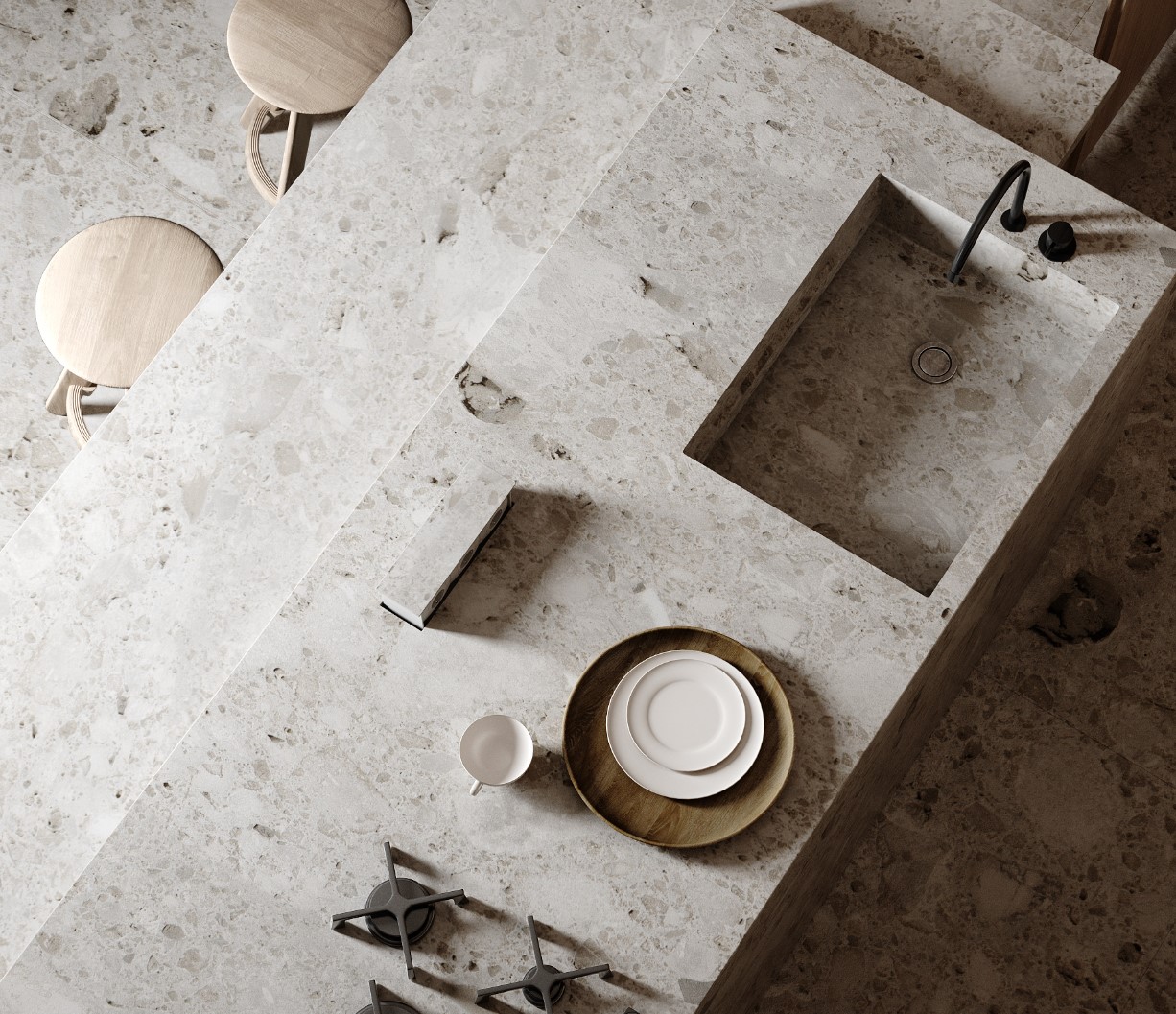
Yes, for most minimalist, Japandi and modern kitchens, an integrated sink gives the cleanest visual result, which is why seamless surfaces feature in our roundup of key kitchen design trends. The countertop flows straight into the basin, so the eye reads one continuous surface instead of a stone top with a steel bowl dropped into it.
You can choose round, square or layered basin designs with curved or straight edges. Matching the sink to a full-height kitchen backsplash in the same stone pushes the look further, which is why integrated sinks are often specified in condo and landed kitchens designed to impress guests.
Is an Integrated Sink Easier to Clean?
Yes. An integrated sink has no rim, lip or silicone bead for food scraps, soap scum and mould to collect in. You wipe the countertop and the sink in one motion.
Compare this with flush mount and undermount sinks, which are popular in new HDB flats. The silicone sealant used at the joint degrades over time, and in Singapore’s humid climate it often turns black with mould within a few years. If you have ever scrubbed that dark line around a sink or tap, you already know the problem an integrated sink removes. (Damp cabinets make it worse; see our tips on how to reduce humidity at home.)
Can an Integrated Sink Be Customised?
Yes. Because the fabricator builds the basin from your slab, the depth, width, shape and layout can be tailored to your kitchen. You can request a single large basin for woks and stockpots, a double basin, a sloped drainboard cut into the countertop, or a twin-sink layout for a shared bathroom vanity. For bathrooms specifically, compare options in which countertop material is best for your bathroom.
What Are the Cons of an Integrated Sink?
Integrated sinks cost more, take longer to fabricate, and are expensive to repair because the sink and countertop are one piece. You should weigh these trade-offs honestly before committing.
Is an Integrated Sink More Expensive?
Yes. An integrated sink costs more than a standard stainless steel sink because the basin is cut, bonded and finished by hand from premium slab material. The final price depends on the material, basin size and how complex the design is, so ask your fabricator for an itemised quote that separates the countertop and the sink fabrication.
Is an Integrated Sink Hard to Repair or Replace?
Yes, and this is the most important drawback. A drop-in or undermount sink can be swapped out on its own. An integrated sink cannot, because it is part of the countertop. Serious damage such as a crack in the basin may mean replacing the sink section or the whole countertop run.
This is why the material you choose matters more for an integrated sink than for any other sink type. A dropped cast iron pot or a heavy mortar and pestle lands in the sink far more often than on the countertop.
Are There Other Limitations?
An integrated sink needs a fabricator with the right equipment and experience, and it adds time to your renovation schedule because the basin is made to order. Stone sinks are also less forgiving than stainless steel: glassware is more likely to chip or break if dropped onto stone.
What Is the Best Material for an Integrated Sink?
Sintered stone is the most durable material for an integrated kitchen sink in Singapore, followed by quartz. Granite is a good choice if you want a natural look and are willing to seal it regularly. For a countertop-level comparison of all three, read sintered stone vs granite vs quartz.


| Property | Sintered stone (MYSA) | Quartz | Granite |
|---|---|---|---|
| Composition | Natural minerals fused at around 1,200°C | About 90% natural quartz bound with resin and pigments | 100% natural stone |
| Porosity | Non-porous | Non-porous | Porous, needs periodic sealing |
| Heat resistance | Up to 300°C | Moderate, resin can scorch, use a trivet | High |
| Scratch resistance | 7 on the Mohs hardness scale | High | High |
| UV resistance | Yes, suitable for alfresco kitchens | No, can yellow in direct sunlight | Yes |
| Look | Wide range, including marble-look veining | Uniform colour and pattern | Unique natural patterns |
Why Choose a Quartz Integrated Sink?
Quartz is an engineered stone with a uniform colour, no sealing requirement and strong stain resistance, which makes it a reliable everyday choice for HDB kitchens. It is also typically more affordable than sintered stone.
- Non-porous and hygienic, a good fit for washing food
- Consistent colour and pattern across the countertop and basin
- Impact resistant and quieter than stainless steel when dishes land in the sink
- Chemical resistant against everyday cleaners
For food-prep hygiene, look for quartz with NSF certification, and for indoor air quality, look for Greenguard certification, which according to UL Solutions verifies that a product meets strict limits on chemical emissions. Aurastone supplies quartz carrying both. On the food-safety side, according to NSF International, its certification confirms a product meets public health and safety standards. The limitation: quartz contains resin, so avoid placing very hot pots directly into a quartz basin and avoid long-term direct sunlight. Explore Aurastone quartz.
Why Choose a Sintered Stone Integrated Sink?
Sintered stone is an ultra-compact surface made by fusing minerals such as feldspar and quartz under extreme heat and pressure (our explainer on what sintered stone is covers the sintering process in detail). MYSA, Aurastone’s own sintered stone range, rates 7 on the Mohs hardness scale, the same rating Britannica gives the mineral quartz itself, and resists heat up to 300°C, so a hot wok or claypot placed in the basin will not scorch or discolour it.
- Non-porous, so water, mould and bacteria cannot soak in
- Stain-resistant against turmeric, curry, soy sauce and coffee
- UV resistant, so the colour holds even in a sunny wet kitchen or outdoor kitchen
- Available in polished and honed finishes
- Matches a sintered stone countertop exactly for an unbroken minimalist look
The trade-off: sintered stone is harder to fabricate than quartz, so choose a fabricator with experience cutting and mitring it. Learn more about sintered stone or browse the MYSA range.
Why Choose a Granite Integrated Sink?
Granite is a natural stone, so every slab has its own pattern and colour. If you want a sink that looks distinctly natural rather than engineered, granite delivers that.
- Unique natural patterns no two kitchens share
- Durable and long-lasting
- Resistant to scratches, impact and heat
The trade-off is porosity. Granite needs sealing to resist stains and water absorption, and a sink basin gets far more water exposure than a countertop. Expect more maintenance than with quartz or sintered stone; our countertop maintenance guide for granite, sintered stone and quartz sets out the routine for each. See Aurastone granite.
Still deciding between materials? Read our full comparison of quartz vs sintered stone for Singapore homes.
Is an Integrated Sink Right for Your HDB, BTO or Condo Kitchen?
An integrated sink suits you if you want a minimalist kitchen, hate scrubbing silicone joints and have the budget for a premium countertop. It is a less obvious fit if you are renovating on a tight budget or expect heavy, rough use in the sink.
For a BTO or resale HDB flat, an integrated sink works well in an open kitchen where the countertop is on display. In a condo, EC or landed home, it is a popular choice for the dry kitchen or island, often paired with a stainless steel sink in the wet kitchen for heavy-duty cooking.
When Might an Integrated Sink Not Be Right for You?
- Your renovation budget is tight. The extra cost may be better spent on a higher-grade countertop with a well-installed standard sink.
- You cook heavily and roughly. If cast iron pots and cleavers land in your sink daily, a stainless steel sink is easier and cheaper to live with.
- You may change the layout soon. An integrated sink is hard to move or swap without replacing the countertop.
- Your renovation timeline is short. A custom basin adds fabrication time.
It also helps to see how other homeowners feel after living with one. Renovation threads on Reddit and HardwareZone have candid discussions on integrated sinks, and Qanvast’s guide to hiring an interior designer is useful if you are still choosing who will coordinate your kitchen works. Not sure whether you need an ID at all? Read interior designer vs contractor.
What If You Want a Leakproof Sink Without a Full Integrated Basin?
If you like the idea of an integrated sink but not the price or repair risk, Aurasink is Aurastone’s patent-pending leakproof kitchen sink system designed to solve sink-edge water seepage. It gives you leak protection without fabricating the basin from stone.
Aurasink uses a new sink design and installation method. A dedicated clamp system holds the sink tightly to the countertop until the silicone cures completely, creating a watertight seal that conventional top mount and undermount installations cannot guarantee.
- Each package includes the Aurasink, a stainless steel strainer and the clamping system
- Aurasink is installed only with selected Aurastone countertop materials, including Aurastone quartz and MYSA sintered stone
- It is not sold separately, so request it through your interior designer, contractor or directly from Aurastone
See how Aurasink prevents sink leakage, and pair it with the right tap using our guide to types of sink faucets in Singapore.
How Do You Plan an Integrated Sink Installation in Singapore?
Plan your integrated sink at the same time as your countertop, before cabinet carcasses are built, because the basin size, drain position and tap holes all affect the cabinet below. Here is the typical sequence:
- Choose your material and basin design at a showroom, ideally with the full slab in view. Browse the Aurastone inspiration gallery first to shortlist looks.
- Confirm sink dimensions with your interior designer or contractor so the cabinet, plumbing and tap positions match.
- Check renovation rules. HDB owners should review the HDB renovation guide on MyNiceHome before kitchen works begin. Condo and landed owners should check with their MCST or contractor, as building works also fall under Building and Construction Authority (BCA) rules.
- Templating. Once cabinets are installed, the fabricator measures on site for an exact fit.
- Fabrication and installation. The countertop and basin are cut, bonded, finished and installed as one unit.
Before you sign off on the kitchen, run through these renovation mistakes to avoid. Working with limited space? See our small HDB kitchen countertop hacks. Once your sink is in, our post-renovation checklist for HDB homeowners helps you inspect it properly.
Find the Right Sink for Your Kitchen
Whether you choose a fully integrated sink, a leakproof Aurasink or a well-installed standard sink, the goal is the same: a kitchen that stays dry, clean and good-looking for years. The easiest way to decide is to see the materials in person. Drop by the Aurastone | UNIX Experience Center at Blk 12 Marsiling Industrial Estate Road 9, #01-16, bring your kitchen layout, and our team will walk you through integrated sink options in sintered stone and quartz, along with Aurasink, so you can plan your countertop before your renovation starts. You can also read what other homeowners say in our customer reviews.
Frequently Asked Questions
What is an integrated kitchen sink?
An integrated kitchen sink is a basin made from the same material as the countertop and fabricated as one continuous unit with it. There is no rim or silicone joint between the sink and worktop. In Singapore, integrated sinks are commonly made from sintered stone, quartz or granite.
Are integrated kitchen sinks in Singapore worth the cost?
An integrated sink is worth it if you value a seamless look and low-maintenance cleaning, and you have room in your renovation budget. It removes the silicone joint where most sink leaks and mould begin. If budget is tight or you cook roughly, a well-installed stainless steel sink or a leakproof sink system may be better value.
Do integrated sinks leak?
Integrated sinks are far less likely to leak at the sink edge because there is no joint between the basin and the countertop. Leaks can still occur at the drain or tap fittings if plumbing is poorly installed, so use an experienced fabricator and plumber.
What is the best material for an integrated sink?
Sintered stone is the most durable material for an integrated sink, with heat resistance up to 300°C and a Mohs hardness of 7. Quartz is a strong, more affordable alternative but should be protected from very hot pots. Granite offers a natural look but needs regular sealing.
Can you put an integrated sink in an HDB kitchen?
Yes, an integrated sink can be installed in BTO and resale HDB kitchens as part of a countertop replacement. Plan it with your interior designer before the cabinets are built, and check HDB’s renovation guidelines on MyNiceHome before works begin.